Best Air Conditioners for Trailers: Top RV Rooftop Units
Trailer living often calls for compact, efficient cooling that won’t drain a battery or require a full-size AC unit. The right RV rooftop air conditioner can deliver quick comfort, operate on 12V or 110V power, and fit a range of trailer sizes. Below you’ll find five well-regarded options that balance cooling power, energy efficiency, and install ease. This guide highlights performance in real-world conditions for American RVers, campers, and travel trailer owners seeking dependable climate control.
Summary at a glance: the table below lists five premium trailer air conditioners, with key specs and notable strengths to help you compare quickly. All units are suited for rooftop installs and designed for mobile use.
| Product | Brand | Approx BTU / Heating (if any) | Key Strength | Installation Notes |
|---|---|---|---|---|
| RV Air Conditioner, 12V 10000 BTU Rooftop | outequip | 10,000 BTU cooling; 4,500 BTU heater | Fast cooling; supplementary heating; weather-resistant | Low-profile; battery-powered capable |
| RecPro 15K Ducted/Non-Ducted | RecPro | 15,000 BTU | Low amp draw; quiet operation | Versatile install options; durable shell |
| Treeligo 12V Ultra-Quiet | Treeligo | ~7,900 BTU cooling; 3,000 BTU heating | Energy efficient; battery-friendly | Roof-mounted; easy install |
| FOGATTI InstaCool 13.5K | FOGATTI | 13,500 BTU | Dual compressors; fast cooling | Requires 115V AC and 12V DC power |
| Furrion Chill Cube 18K | Furrion | 18,000 BTU | Variable speed; high efficiency | Lightweight; AC unit only |
RV Air Conditioner, 12V 10000 BTU Rooftop (outequip)

The outequip rooftop unit delivers 10,000 BTU of cooling capacity with a rapid 15-minute cooling response, making it suitable for mid-sized trailers and campers that require brisk comfort on warm days. It includes a 4,500 BTU PTC heater to provide supplementary warmth during cooler evenings, which can extend usability into shoulder seasons. The unit is built with UV-stabilized ABS materials, EPDM foam gasket, and a zinc-coated condenser to resist weather and wear, helping to maintain performance across long trips.
This model is designed for compact rooftop spaces and emphasizes a low-profile footprint. While it offers battery-powered operation in theory, practical use depends on your vehicle’s power setup and battery capacity. It is a practical choice for RVers who want a straightforward, durable cooling solution with a built-in heating option for mild weather. The balance of cooling power, heater capability, and weather resistance can make it a strong fit for weekend getaways and off-grid adventures.
RecPro 15K Ducted or Non-Ducted

The RecPro 15K unit combines efficiency with quiet operation. It features a low amp draw, enabling RVers to run multiple appliances without overloading the power system—an important consideration for off-grid setups powered by solar, generator, or limited shore power. The construction uses UV-resistant plastic with an aerodynamic shape to minimize drag and fit a wide range of RVs, campers, and fifth wheels. At about 55 dB of noise in standard operation, it is noticeably quieter than many older rooftop AC units, offering a more restful environment inside the trailer.
Installation versatility makes this model attractive for several RV configurations, including ducted and non-ducted layouts. Its rugged, road-ready design helps it stand up to road trips and varying climates. If you prioritize energy efficiency, quiet performance, and a straightforward install, this unit presents a balanced option for mid-to-large trailers seeking dependable cooling without excessive amperage draw.
Treeligo 12V Ultra-Quiet Non-Ducted
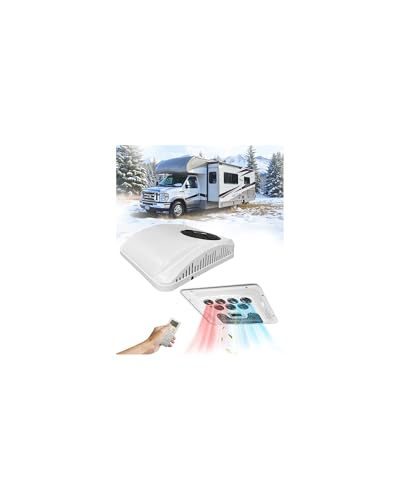
Treeligo’s 12V RV air conditioner emphasizes energy efficiency with a 12V DC scroll compressor that draws from the vehicle’s battery—an option designed to reduce fuel consumption and extend off-grid use. It delivers a cooling capacity around 7,900 BTU and includes a 3,000 BTU heating function for transitional seasons. The unit’s installation is rooftop-focused, and the kit is described as easy to mount on standard roofs with compatible dimensions. The design is aimed at campers and travel trailers seeking lower operating costs and reliable cooling without reliance on large external power sources.
Battery efficiency comes with a caveat: it’s best suited for steady charging environments rather than relying on starter batteries under heavy use. This model is well-suited for users who frequently park in sunny or remote locations and want to maximize battery life while maintaining a comfortable interior climate during both warm and cool periods.
FOGATTI InstaCool 13,500BTU
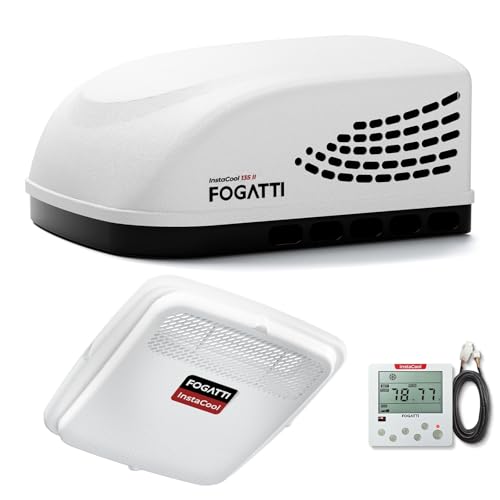
FOGATTI InstaCool 13,500 BTU provides robust cooling power suitable for larger campers and trailers. It integrates dual high-efficiency compressors, enabling rapid cooling with a focus on energy efficiency through eco-friendly refrigerant and advanced control systems. This model requires a connection to both 115V AC and 12V DC power, aligning with setups that have both shore power and a secondary battery system. The all-in-one design simplifies retrofits and on-roof installation, delivering a strong balance of performance and simplicity for users who need quick cooling in larger spaces with a flexible power strategy.
The combination of higher cooling capacity and intelligent temperature regulation supports more even air distribution and reduced runtime to achieve the desired interior climate. As with other high-capacity units, it is best suited for trailers where roof space and electrical readiness align with the unit’s dual-power requirements.
Furrion Chill Cube 18K RV Rooftop

The Furrion Chill Cube 18K is a high-capacity, lightweight rooftop unit designed for off-grid adventures and larger RVs. It features variable-speed compressors to move cool air more efficiently and maximize battery runtime, particularly when paired with solar or generator power. This unit is “AC unit only” with ADB components sold separately, which means the installation may require additional purchase steps, but the payoff is greater cooling efficiency and more precise climate control inside the trailer. Its 18,000 BTU capability provides significant headroom for hot climates or larger living spaces within the RV.
The unit emphasizes quiet operation and energy efficiency, balancing cooling power with reduced energy draw. It is well-suited for users who demand strong performance, flexible power options, and the ability to maintain comfortable temperatures in larger trailers or during peak summer conditions.
Buying Guide: Key Purchase Considerations For Trailer A/C
When selecting an air conditioner for a trailer, several factors determine long-term satisfaction and performance. Consider these perspectives to tailor a choice to your setup, climate, and power availability.
- Cooling capacity (BTU): For smaller trailers, 7,900–10,000 BTU models are often sufficient for single-use spaces or mild climates. Larger trailers or hot climates may justify 13,500–18,000 BTU units, especially if the unit must cool quickly after parking in the sun.
- Power source compatibility: Some units emphasize 12V DC operation, which suits off-grid or battery-backed setups. Others require 110V AC or dual-power configurations. Ensure your electrical system can handle the load without tripping breakers or draining batteries too quickly.
- Energy efficiency: Look for models with low amp draw, efficient compressors, and smart temperature regulation. Eco-friendly refrigerants and variable speed controls contribute to energy savings over time.
- Noise levels: Quiet operation improves comfort for sleeping and relaxing inside the trailer. Vendors often quote decibel levels around 50–60 dB; compare under typical operating conditions.
- Installation compatibility: Roof size, mounting pattern, and required clearances determine how easily a unit fits your trailer. Some units are easier to install with ducted or non-ducted configurations, while others require additional components or adapters.
- Durability and weather resistance: UV stabilization, gasket insulation, and corrosion resistance extend the life of rooftop units exposed to sun, rain, and road debris.
- Maintenance and serviceability: Consider models with readily available replacement parts, straightforward filter access, and clear installation guides to simplify repairs or upgrades on the road.
- Off-grid viability: For campers relying on batteries or solar, prioritize units designed for low power draw and compatibility with off-grid power systems. Calculate daily energy consumption to ensure it aligns with available resources.
- Warranty and support: A solid warranty and accessible customer support reduce risk for long trips and remote locations where service options are limited.
Choosing the right trailer air conditioner involves balancing capacity, power availability, and installation effort with your typical travel environment. A higher BTU unit can cool more quickly in sunny climates but may require more electrical power. Conversely, smaller or more energy-efficient units extend off-grid viability but may struggle in extreme heat. In every case, ensure the unit’s dimensions, roof cutouts, and mounting pattern align with your trailer’s design and existing roof hardware. For some owners, a dual-system approach—one primary air conditioner paired with a secondary, lower-capacity unit—can provide flexible cooling while moderating power usage.