Best Air Conditioning for Offices: Efficient Cooling for Workspaces
Choosing the right cooling solution for an office can improve comfort, productivity, and energy use. This guide highlights five office-friendly cooling options ranging from tower fans to portable and windowless air conditioners. Each product is evaluated on cooling power, energy efficiency, noise levels, and ease of use to help facilities managers and remote workers decide what fits best in a shared or home office.
| Product | Brand | Key Benefit |
|---|---|---|
| Dreo Tower Fan (DR-HTF007) | Dreo | High airflow with quiet operation and timer features |
| Kaniapu Portable Air Conditioner | Kaniapu | Freon-free, USB-powered cooling with low energy use |
| COOLECH Windowless Air Conditioner | COOLECH | 4 modes, 4 speeds, smart water alert for dry climates |
| Midea EasyCool Window AC | Midea | 3-in-1 cooling, dehumidifier, and fan with remote |
| Piegricdiat Portable Air Conditioner | Piegricdiat | Ice-cooled airflow with low-noise operation |
The following product sections summarize practical use cases, performance highlights, and what to consider when selecting an office cooling solution—from small workspaces to shared desks and conference areas.
Dreo Tower Fan For Office Spaces

This 36-inch tower fan delivers strong airflow with a compact footprint ideal for office corners and break areas. It features 25 ft/s maximum wind speed and 8-hour timer options to control cooling without constant adjustment. The unit’s design emphasizes quiet operation, with an algorithmic impeller and Conada-effect approach to minimize noise during long workdays. A removable rear grille and safety features support easy cleaning and safe usage in shared spaces. A 90° oscillation helps distribute air across workstations, making it suitable for open-plan offices.
Kaniapu Portable Air Conditioner For Desks

Designed for personal cooling in desks, dorms, and small offices, this unit emphasizes energy savings and eco-friendliness. It uses a Freon-free system with low energy consumption, making it a cost-conscious option for space up to a few hundred square feet. The USB-powered operation enables flexible placement without relying on a full HVAC line, and its compact profile supports placement on desks or shelves. A single water refill typically lasts several hours, and the device operates with minimal noise for uninterrupted work.
COOLECH Windowless Air Conditioner
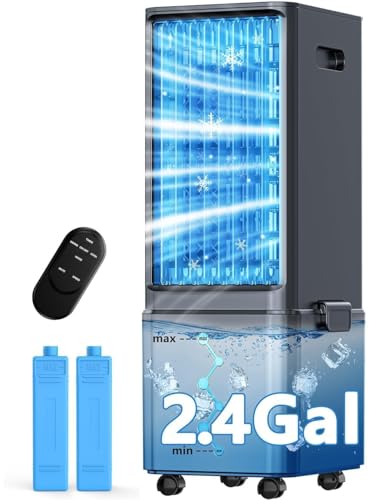
This evaporative cooler provides 4 modes and 3 wind speeds, delivering up to 22 ft/s of airflow. The windowless design makes installation straightforward in rooms without wall space for traditional units. A waterless alert system helps prevent dry-out and motor strain by prompting a switch to Natural Mode when water depletes. The large set of features includes cooling, normal, natural, and sleep modes, allowing tailored comfort for dry climates or energy-conscious offices.
Midea 5,000 BTU EasyCool Window AC

This compact window unit cools spaces up to 150 sq. ft. with 7 temperature settings and 3 modes (cool, fan, dehumidify). It includes a remote control for convenient adjustments from a desk or chair. The unit emphasizes energy efficiency with a CEER rating and is designed for relatively easy installation in standard window frames. It operates quietly—close to refrigerator-level noise in low settings—making it suitable for small offices or home workspaces where quiet operation matters.
Piegricdiat Portable Air Conditioner With Ice Cooling

This portable unit emphasizes upgraded ice cooling technology for faster relief from heat. It is designed for quiet operation below 30 decibels, making it suitable for offices and meeting rooms. The device uses a dynamic ice cooling system and includes two freezer packs to extend cooling duration, ideal for hot summer days in shared workspaces. The compact form supports mobility between desks, conference rooms, and small offices.
Buying Guide: Key Purchase Considerations
When selecting an office cooling solution, consider room size, noise tolerance, and energy usage. Tower fans like the Dreo model are cost-effective for open layouts but may be less effective in very hot climates without airtight spaces. Portable air conditioners offer targeted cooling for individual desks or small rooms but require venting and a steady power source. Windowless evaporative coolers deliver humidity into dry environments, which can improve comfort but may be less effective in humid climates.
Device noise and airflow distribution matter for productivity. Consider units with adjustable oscillation, multiple speed settings, and sleep or timer functions to minimize disturbances during work hours. For shared spaces, prioritizing devices with automatic shutoff, safety features, and easy cleaning helps maintain a healthier environment. Energy efficiency ratings and power sources (USB-powered, standard outlets, or window venting) will influence ongoing operating costs and installation complexity.
Durability and safety are essential for office deployments. Look for ETL-listed or certified products that include protective grilles, fused plugs, and cooling components designed for frequent use. Easy maintenance—removable grills, washable filters, and clear user manuals—reduces downtime and improves long-term reliability in a busy office setting.
For mixed environments, a combination approach often works well: a high-capacity tower fan to circulate air throughout the space and a smaller portable AC unit for isolated hot spots such as individual desks or meeting rooms. Always measure the workspace, identify heat sources, and test cooling patterns before finalizing a purchase.
Additional considerations include replacement filters, warranty terms, and vendor support. If you operate in a climate with high humidity, dehumidification modes can improve comfort and efficiency. Conversely, in very dry climates, humidification options may be beneficial to maintain comfortable air quality. Evaluate maintenance cycles and availability of replacement parts when selecting a model for office use.