Best Air Conditioner Solar Power System Options for Off-Grid Comfort
Exploring air conditioning solutions that work with solar power helps maintain comfort while reducing grid dependence. This guide features five solar-ready or solar-friendly cooling options, spanning hybrid mini splits, battery-ready units, soft-start systems, and solar-powered vehicle cooling. Each selection prioritizes energy efficiency, compatibility with solar setups, and reliable performance for American homes and off-grid applications.
| Product | Brand | Solar/Power Feature Highlight | Key Suitability |
|---|---|---|---|
| Stealth Solar Ready 12000 BTU Mini Split | STEALTH COMFORT | Hybrid power: grid or 90–380V DC solar inputs; solar-ready for solar panel integration | Home or small commercial spaces up to ~1200 sq ft |
| Nexmetal 48V DC Battery Powered Mini Split | Nexmetal | Runs on 48V DC; designed for off-grid or battery-tied solar systems; no inverter required | Off-grid cabins or vehicles needing battery-centric cooling |
| SoftStart Home Soft Starter for A/C | SoftStartRV By NetworkRV | Reduces startup current; compatible with generators, RVs, and solar; extends compressor life | Existing heat pumps/ACs with solar or generator power |
| BIHYNGAIR 12V DC Split A/C System | BIHYNGAIR | 12V DC powered; mobile/vehicle cooling; 1800W cooling capacity | RVs, vans, semis, and mobile work sites |
| LALADEFIEE Car Solar Air Conditioner | LALADEFIEE | Solar-powered car cooling; uses solar energy to operate without pulling power from the car | Solar-powered vehicle cooling for on-the-go comfort |
Below, five selected products are detailed with features, design intent, and practical considerations for solar-based cooling. Each section includes a direct link to the Amazon product page and an accompanying image for quick visual reference.
Stealth Solar Ready 12,000 BTU Mini Split

The Stealth Comfort Solar Ready mini split is designed for spaces from 400 to 1200 square feet, with a flexible power approach that supports both standard grid electricity and solar panel integration. It offers a 22.5 SEER2 cooling efficiency, wide temperature operation, and a hybrid power setup that accepts 115V AC utility power or 90–380V DC solar inputs. The system prioritizes solar when available and automatically switches to grid power to maintain continuous operation, making it suitable for sunny homes or small commercial rooms seeking energy resilience.
Key features include a robust cooling range, efficient heating, and a solar-ready architecture, which help in reducing energy costs when paired with a properly sized solar array and energy storage solution. Installation typically requires professional attention to ensure proper DC wiring and safety clearances for solar integration.
Nexmetal 48V DC Battery Powered Mini Split

The Nexmetal unit runs native on 42–59 V DC and is designed for off-grid use or battery-tied solar systems. It supports a true 48V DC compressor and fans, eliminating the need for an inverter for higher efficiency. The system can provide heating as well as cooling, and it remembers the last operating state after power interruptions for up to 24 hours. This configuration is well-suited for remote cabins, RVs, or any application where battery storage is a core part of the power plan.
Considerations include the need for an appropriately sized 48V DC energy source and compatible solar charging setup. While highly efficient in DC mode, the overall system performance depends on the battery chemistry, depth of discharge, and solar charging rate available on-site.
SoftStart Home – Soft Starter For A/C & Heat Pumps
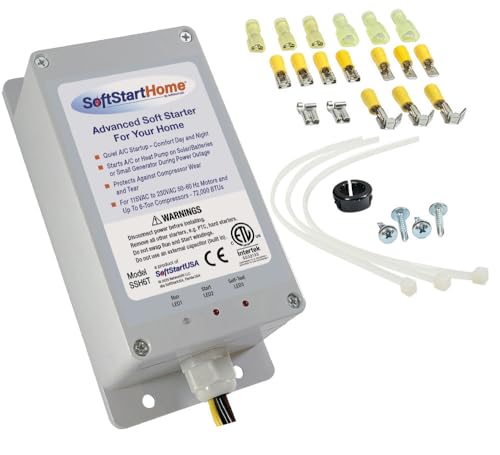
The SoftStart Home soft starter reduces startup power by up to 70%, smoothing inrush and minimizing flicker in solar-powered or generator-backed systems. It is designed to be compatible with various AC units and heat pumps, extending compressor life by reducing startup stress. The product is particularly useful in off-grid configurations where battery capacity is limited or when generators are used to supplement solar during peak loads or cloudy days.
Practical use involves ensuring correct matching with the specific AC model’s electrical characteristics. The device is a retrofit option that can improve the reliability of solar-assisted cooling, especially in RVs, cabins, or remote homes where power fluctuations are a concern.
BIHYNGAIR 12V DC Split A/C System

This 12V DC split system delivers 1800W cooling capacity and is designed for mobile applications such as RVs, vans, semi trucks, and construction vehicles. The DC-powered design supports off-grid setups, reduces the need for inverters, and aligns with solar-powered battery banks. It is particularly appealing for users requiring reliable cooling on the move or in small, energy-constrained spaces where a standard 110–120V supply is unavailable.
Users should account for the DC supply chain in a mobile solar system, including voltage regulation, battery capacity, and the potential need for a dedicated solar charge controller to maintain stable operation and battery health.
LALADEFIEE Car Solar Air Conditioner

This car solar air conditioner is designed to operate using solar energy to power the cooling fan system, reducing reliance on the vehicle’s engine or auxiliary power. It is positioned as a solar-powered cooling option for vehicles, offering energy conservation without taxing the car’s electrical system. It is best suited for hot-weather driving and parking scenarios where solar exposure is high and on-demand cooling is desired without drawing power from the car’s alternator.
Important considerations include compatibility with vehicle electrical systems, the efficiency of solar panels, and potential need for battery storage to sustain operation during intermittent sunlight or cloud cover.
Buying Guide: Key Purchase Considerations
- Solar compatibility and power strategy: Decide whether you want grid-to-solar hybrid (stepping between utility and solar), 48V DC battery-powered systems, or purely DC-powered units. Each approach has different requirements for solar panels, charge controllers, and energy storage.
- System efficiency: Look for high SEER or SEER2 ratings, inverter technology, and features like auto defrost and variable-speed compressors. Higher efficiency translates into lower energy draw from solar arrays and batteries.
- Cooling capacity vs. space: Match BTU or cooling capacity to the intended area. Oversized units waste energy; undersized units struggle to meet comfort targets, especially on sunny days.
- Power resilience: For off-grid use, consider soft-start devices and systems that tolerate variances in solar input or generator backup. Soft-start reduces inrush energy, preserving battery life and stability.
- Installation considerations: Hybrid DC systems require careful electrical design and appropriate DC wiring or inverter options. Vehicle or RV applications demand compact, robust solutions with durable components and vibration resistance.
- Maintenance and longevity: Evaluate compressor design, warranty terms, and service availability. DC and solar-ready units may have longer lifespans when paired with properly sized solar storage and climate control management.
- Portability and use-case fit: Car and mobile cooling solutions emphasize compact form factors and low power consumption, while home installations prioritize integrated control and ductless configurations for flexible layouts.
- Energy storage and management: For solar-enabled cooling, plan battery storage, charge controllers, and power management strategies to balance daytime solar production with nighttime or cloudy-day needs.
- Noise and comfort: Consider inverter-driven compressors and fan designs that minimize noise for bedrooms or workspaces, especially in portable or RV settings.