Best Stainless Steel Pool Heat Exchangers for Efficient Heating
Stainless steel pool heat exchangers offer durable, corrosion-resistant solutions for heating swimming pools, spas, and hot tubs. This guide highlights five top-rated models that balance efficiency, longevity, and value. Each product is evaluated on materials, heating capacity, compatibility, and warranty to help American homeowners and pool professionals choose the best option for their systems.
Summary of selected products:
| Product | Brand | Key Benefit | Typical Use |
|---|---|---|---|
| AB Pool Heat Exchanger 155kBtu | AB | 316L stainless steel, 11,900 gallon capacity | Pools, spas, small to mid-size systems |
| 200K BTU Stainless Steel Heat Exchanger | OtaniReno | Large heating capacity, salt-water resistant | Residential pools and spas |
| DEIGEHJRE Pool Heat Exchanger 200k | DEIGEHJRE | 304 stainless steel, fast heating | Pools, spas, hot tubs |
| Jiabailie 200KBTU Swimming Pool Exchanger | Jiabailie | Durable 304 stainless steel, efficient heat transfer | Swimming pools, hot tubs, solar compatible |
| AB Pool Heat Exchanger 300 kBtu | AB | 316L stainless steel, high capacity | Large pools, spa setups, solar heating |
AB Pool Heat Exchanger 155kBtu Stainless Steel

Product overview: The AB 155 kBtu heat exchanger is fully constructed from high-grade stainless steel 316L, offering corrosion resistance for pool, spa, and hot tub setups treated with chemicals. It supports a heating capacity suitable for larger residential pools and spas. The unit is designed for reliability in humid, chlorinated environments and includes a one-year manufacturer warranty. Its same-side ports simplify installation for reduced piping complexity.
200K BTU Stainless Steel Heat Exchanger

Product overview: This 304 stainless steel heat exchanger emphasizes durability and long service life, making it suitable for both pools and spas. It transfers heat indirectly between hot water circuits and pool water, ensuring a stable temperature. With a 60°C (140°F) temperature difference, it can deliver up to 200 kBtu/hr, enabling faster heating for quicker pool readiness.
DEIGEHJRE Pool Heat Exchanger 200k
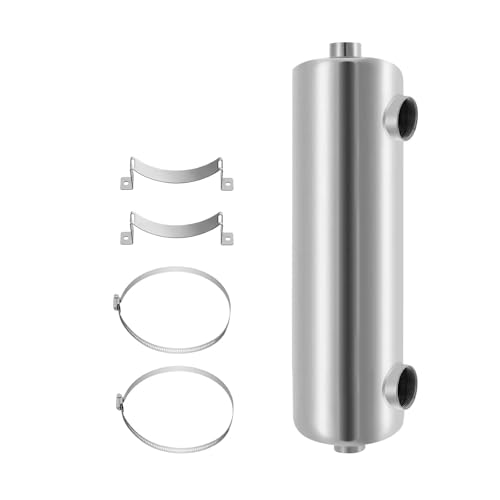
Product overview: The DEIGEHJRE unit uses 304 stainless steel for solid durability with similar fast-heating characteristics. It supports multiple connection sizes (1-inch and 1-1/2-inch FPT) and is designed to maintain a consistent water temperature across hot water and pool lines. Its 200 kBtu/hr capability aligns with typical mid-to-large residential pools and spa installations.
Jiabailie 200KBTU Pool Exchanger

Product overview: The Jiabailie exchanger uses 304 stainless steel for durability and strong heat transfer. It supports 1″ and 1-1/2″ FPT ports and offers a heat transfer area designed for effective performance in pools, hot tubs, and solar heating setups. It emphasizes a constant temperature approach with rapid heating, suitable for owners seeking reliable daily use.
AB Pool Exchanger 300 kBtu Stainless Steel
Product overview: The AB 300 kBtu exchanger is designed for larger pools and solar heating systems, built from 316L stainless steel. It offers robust corrosion resistance and a one-year warranty. The unit’s high capacity makes it suitable for substantial pool ecosystems and spa installations that demand greater heating output.
Buying Guide: Key Considerations For Stainless Steel Pool Heat Exchangers
- Material and corrosion resistance: Look for 304 or 316L stainless steel to withstand chlorinated water and chemical treatments common in pools and spas.
- Heating capacity: Choose a unit that matches your pool size and desired heating rate. Larger gallons and higher Btu ratings will heat more quickly but may require a bigger heat source and proper plumbing.
- Port size and compatibility: Confirm port sizes (FPT 1″, 1-1/2″, etc.) to ensure seamless integration with existing circulation systems and solar loops.
- Temperature differential: Most units specify performance at a 60°C (140°F) difference. Ensure your heating source can achieve or exceed this differential for optimal performance.
- Installation and routing: Some units feature same-side ports for easier installation and reduced piping complexity, which can lower installation costs and potential leak points.
- Saltwater considerations: If your pool uses saltwater sanitization, verify corrosion resistance and warranty terms for salt exposure.
- Warranty and service: A standard 1-year warranty covers defects, but check what is included in the warranty and whether extended coverage is available.
- System integration: Ensure compatibility with existing heaters, solar panels, heat pumps, or boiler loops. Some exchangers are better suited for indirect heat transfer between circuits of different temperatures.
- Maintenance access: Some designs offer easier cleaning and inspection access, which helps sustain efficiency over years of use.
- Safety considerations: Properly sized valves and flow control should be used to avoid excessive pressure and to maintain pump efficiency.
Each selected model provides a balance of durability and performance for American pool owners. When evaluating options, consider pool size, existing heating methods, chemical treatment, and whether you plan to expand to solar heating or spa installations. Always follow manufacturer guidelines for installation and maintenance to preserve efficiency and longevity.