Best BTU Water Heaters for RVs and Outdoor Use
When selecting a tankless water heater for RVs, camping, or remote locations, the BTU rating, flow rate, and safety features matter most. This guide highlights five high-BTU models that deliver reliable hot water on the go, with notes on efficiency, installation, and protection features. Each choice emphasizes strong heating power, portability, and practical performance for outdoor adventures.
Summary of selected products include widely varied BTU outputs to match different needs—from compact units for limited space to high-capacity models for multiple fixtures. The table below provides quick comparisons to help you pick a unit that balances hot water demand with available propane or electric power.
| Product | |||
|---|---|---|---|
| Baotree 8L Tankless Water Heater | 40,824 BTU | 2.11 | Compact camping showers |
| Nessxa 14L Tankless Water Heater | 85,300 BTU | 3.66 | Moderate hot water for RVs |
| Baotree 4.76 GPM RV Water Heater | 115,425 BTU | 4.76 | Higher demand showers |
| Poukaran 65,000 BTU RV Heater | 65,000 BTU | — | High-altitude, reliable hot water |
| Rinnai RX199iN Condensing Heater | 199,000 BTU | Up to 11.1 | Whole-home performance |
Baotree 8L Tankless Water Heater

The Baotree 8L tankless unit delivers up to 40,824 BTU per hour and can heat water to about 113°F, starting from as low as 17°F. It supports a hot water flow of 2.11 GPM, with a pressure range from 3.6 to 116 PSI. Six safety protections guard against overheating, dry firing, antifreeze, low flow, flame faults, and high water pressure. Its compact, portable design makes it suitable for RVs, camping showers, and pet baths, with a simple one-button shower head to minimize water waste.
Nessxa 14L Tankless Water Heater

With 85,300 BTU/hour, Nessxa delivers 3.66 GPM, providing faster hot water for multiple outlets. It shares the same robust safety framework—overheat protection, dry combustion protection, antifreeze protection, low-flow protection, flame fault protection, and high water pressure protection. The 14L capacity is well-suited for mid-sized RVs or camping setups where dependable showers are a priority, while maintaining portable design for easy transport.
Baotree 4.76 GPM RV Water Heater
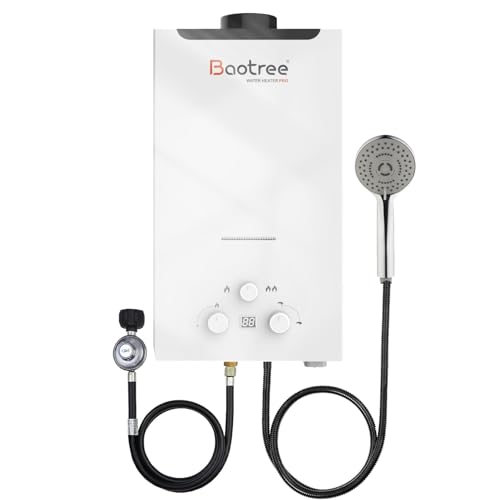
This 18L Baotree unit delivers a high BTU output of 115,425 BTU/hour and a hot-water rate of 4.76 GPM. It is designed for RV use with a portable footprint and six safety protections identical to other models in the line. The one-button shower head helps conserve water, while the higher flow rate supports more demanding hot-water needs during extended trips or when multiple taps are in use simultaneously.
Poukaran 65,000 BTU RV Tankless Water Heater

Poukaran’s 65,000 BTU on-demand unit emphasizes high-altitude performance and energy efficiency with an oxygen-free copper heat exchanger and a brushless DC fan. It supports continuous hot water for RV use with dual outlets for interior and exterior connections, making it versatile for camping, pet bathing, or outdoor activities. The design focuses on reliable start-up at varying pressures while maintaining efficient combustion.
Rinnai RX199iN Condensing Tankless Heater

Rinnai’s RX199iN is a high-capacity, condensing unit rated up to 199,000 BTU and capable of delivering up to 11.1 GPM. It is designed for indoor or outdoor installation with Versa Vent compatibility and supports propane or natural gas through a Smart Sense gas control system. Its compact form belies its power, offering a modern interface, Quick Flush, and an energy efficiency factor (UEF) of .98. WiFi-ready control via a separate module enhances monitoring and performance optimization.
Buying Guide: Key Purchase Considerations And Comparisons
BTU rating is central to hot-water delivery, but it must align with your water usage, climate, and fuel source. Higher BTU units heat water quickly and support multiple outlets, but require adequate power or propane supply and proper venting for safety. Consider the following:
- Hot-water demand: Assess the number of simultaneous outlets (shower, sink, outdoor rinse) and required GPM. Higher GPM often pairs with higher BTU, but usability depends on pressure and temperature rise in your climate.
- Fuel source and installation: Gas-powered units need venting and gas supply lines; electric models require a suitable electrical service. Choose a model compatible with your RV or home setup and local code requirements.
- Temperature rise: In colder climates, a higher BTU unit can maintain comfortable temperatures even when incoming water is cold. If you’re in mild conditions, a lower BTU model may suffice while saving fuel or electricity.
- Protection features: Look for overheating protection, dry-fire protection, low-flow protection, and pressure safeguards. These features reduce risk and extend lifespan in mobile environments.
- Portability vs. capacity: Portable units excel for RVs and camping, while larger units provide better resilience for high demand. Balance weight, size, and mounting options against your vehicle or campsite space.
- Maintenance and serviceability: Models with accessible serviceable parts and clear installation instructions simplify field repairs. Some brands offer field-serviceable elements, making maintenance easier on the road.
Across the options above, you’ll see a spectrum from compact 40k BTU units ideal for single-user showers to ultra-high BTU systems capable of multi-outlet performance. The final choice should reflect your typical water usage pattern, climate, and whether you prioritize portability, ease of installation, or maximum simultaneous hot water supply.