Best Dehumidifier With Drain Hose for Basement
Choosing a dehumidifier with a drain hose keeps basement moisture under control without constant manual emptying. The options below are selected for basements and large rooms, offering built-in drainage, energy efficiency, and quiet operation. This guide compares models with drain hose capabilities to help you pick the right size and features for your space.
| Product | Best Use | Drain Hose Option | Room Coverage |
|---|---|---|---|
| Vinburg Dehumidifier For Home | Basement, Bedroom, Bathroom | Yes | Up to 800 sq.ft |
| AEOCKY Max 80 Pint | Basement, Large Rooms | Yes | Up to 4500 sq.ft |
| VEAGASO 34 Pint | Basement, Living Areas | Yes | Up to 2500 sq.ft |
| Waykar 80 Pint | Basement, Home | Yes | Up to 5000 sq.ft |
| KeepGlad 98 Pint | Basements, Offices | Yes | Up to 5500 sq.ft |
Note: Each model supports a drain hose option for continuous drainage, helping maintain consistent humidity control with less manual intervention. Consider your basement size, desired humidity range, energy efficiency, and noise tolerance when selecting a unit.
Vinburg Dehumidifier For Home With Drain Hose

The Vinburg model uses upgraded dual-core semiconductor condensation technology to efficiently remove moisture from indoor air. It is suitable for bedrooms, bathrooms, basements, and RVs, with doors and windows closed during operation for best performance. It offers Day and Sleep modes—Sleep Mode reduces noise to below 30 dB and turns off lights, ideal for bedrooms and nurseries. The unit includes a timer with 8, 16, or 24-hour options for energy savings and continuous humidity control.
AEOCKY Max 80 Pint Dehumidifier With Drain Hose

The AEOCKY unit emphasizes energy efficiency with a 2025 Most Efficient Energy Star rating. It targets large homes and spaces up to several thousand square feet, delivering up to 80 pints per day in hot, humid conditions. A robust “blue hydrophilic aluminum foil” heat exchange and copper piping support reliable performance. The product notes caution about total ownership costs, highlighting energy savings over time and the importance of considering ongoing electricity use alongside upfront price.
VEAGASO 34 Pint Dehumidifier With Drain Hose

VEAGASO provides a compact, 34-pint-per-day dehumidifier suitable for basements and large rooms. It includes two drainage options: automatic shutoff when the tank is full or continuous drainage via the included hose. The intelligent touchscreen control makes it easy to set humidity levels, timer, and fan speed. A compact form factor with dual drainage helps maintain moisture control without frequent maintenance.
Waykar 80 Pint Dehumidifier With Drain Hose
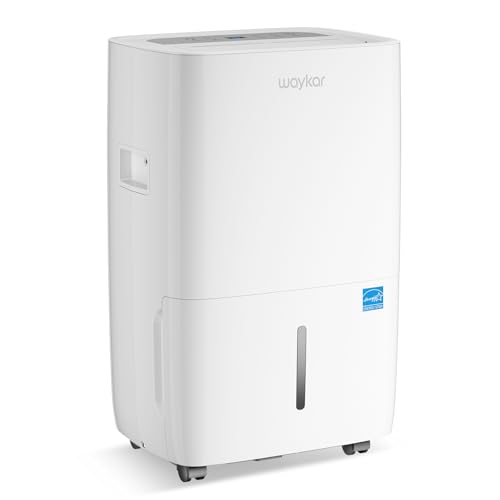
Waykar’s 80-pint unit covers up to 5,000 square feet, making it suitable for large basements and homes. It features Energy Star 2025 certification, offering significant energy savings. A wide-angle 30°–90° swing promotes faster, targeted dehumidification, and noise can be as low as 42 dB, preserving quiet spaces like bedrooms. A drain hose and water tank provide flexible drainage options for continuous use.
KeepGlad 98 Pint Dehumidifier With Drain Hose
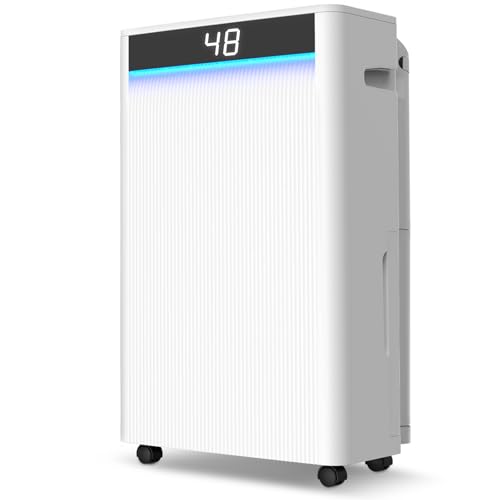
KeepGlad advertises up to 98 pints per day in peak summer conditions, suitable for very large basements and spaces over 5,500 sq.ft. It includes smart humidity control with a humidity compensation algorithm and color-coded lighting to indicate real-time humidity levels. The unit offers automatic defrost, automatic restart after power outages, and two drainage modes (tank with full indicator or continuous drain via hose) for uninterrupted operation.
Buying Guide: Key Purchase Considerations
- Space size and dehumidifier capacity: Match the unit’s pint-per-day (PPD) rating to your basement size and humidity levels. Larger spaces may require 60–80 PPD units, while smaller basements can use 20–30 PPD models.
- Drain hose vs. tank: A continuous drainage option with a hose is ideal for basements or finished spaces where you cannot easily empty a tank. Check hose length and compatibility with your sump or drain location.
- Energy efficiency: Look for Energy Star certification and modern compressor technology. Energy-efficient models reduce operating costs over time, especially in damp, year-round basements.
- Noise levels: Basement units should be whisper-quiet to avoid disrupting living spaces. Noise is often listed in decibels (dB); aim for 40–50 dB for bedrooms or living areas.
- Controls and features: A digital humidistat, auto-defrost, timer, and memory of last settings add convenience. Some units offer auto-start after power outages and child locks for safety.
- Durability and maintenance: Check filter accessibility, tray safety shutoffs, and build quality. Copper refrigerant lines and durable construction tend to last longer in basements with higher humidity.
- Placement and airflow: Consider the unit’s air outlet direction, the ability to swing or direct airflow, and whether the device needs to be near a wall, corner, or drain.
- Future-proofing: If you anticipate expanding or upgrading your basement, a unit with higher capacity and flexible drainage will be more adaptable than a smaller model.