Best Evaporative Cooler Options for Greenhouses to Keep Plants Cool
Greenhouses demand reliable, energy-efficient cooling that protects plants without harsh AC. Evaporative coolers offer high airflow, lower costs, and easier maintenance for greenhouse environments. This guide highlights five top outdoor and portable evaporative coolers suited to greenhouse spaces, with practical considerations for size, cooling capacity, water needs, and mobility.
Summary of Selected Products
| Product | Brand | Approximate CFM | Tank / Water | Key Benefits |
|---|---|---|---|---|
| Portable Swamp Coolers MC18M | Hessaire | 1,300 | Tank-based | High efficiency, wide air coverage, simple operation |
| GarveeHome 3000 CFM Evaporative Cooler | GarveeHome | 3,000 | 12H Timer, Ice packs | Remote control, versatile modes |
| Hessaire MC37M | Hessaire | 3,100 | Tank-based | 3-panel intake for extended coverage, simple use |
| COOLECH Windowless Evaporative Cooler | COOLECH | Up to 22 ft/s air speed | Waterless alert, 20ft remote | 4 modes, 3 speeds, portable and dry-area suited |
| Auertech 48″ Swamp Cooler | Auertech | 6,500 | 19 Gal + 8 Ice Packs | Large capacity, strong cooling, flexible placement |
Hessaire MC18M 1300 CFM Evaporative Cooler

The Hessaire MC18M delivers 1,300 CFM of evaporative cooling with a high-density XeL50 media designed to maximize air intake and efficiency. Its design targets larger greenhouse spaces by expanding air coverage and reducing energy usage, potentially cutting electricity consumption by up to 50% compared to less efficient models. A single cooling pad configuration supports straightforward maintenance and reliable operation for day-to-day greenhouse cooling. The unit is portable and simple to set up—fill the tank, plug in, and switch on for immediate airflow. After use, run for 30 minutes to dry before storage.
GarveeHome 3000 CFM Evaporative Cooler

This 3,000 CFM evaporative cooler offers robust cooling suitable for greenhouse bays with higher heat loads. It features three wind speeds and modes (Normal, Natural, Cooling) to customize humidity and airflow. A wireless remote and 12-hour timer simplify scheduling around daylight cycles. The cooler includes four lockable swiveling casters for easy movement and stable placement in variable greenhouse layouts. With a maximum airflow of 3,000 CFM and 450 square feet coverage, it distributes cool air evenly to support plant transpiration balance and humidity control, while making relocation hassle-free when sections of the greenhouse require targeted cooling.
Hessaire MC37M 3100 CFM Evaporative Cooler

The Hessaire MC37M provides 3,100 CFM of evaporative cooling in a portable design ideal for greenhouse spaces that demand more aggressive air movement. Its 3-panel intake system enhances air distribution, expanding coverage and improving humidity balance without over-saturating the environment. The unit is designed for continuous operation with steady water flow, enabling several hours of cooling per fill cycle. Its compact footprint makes it adaptable for various greenhouse layouts, making it a practical option when space is at a premium but airflow is critical.
COOLECH Windowless Evaporative Cooler
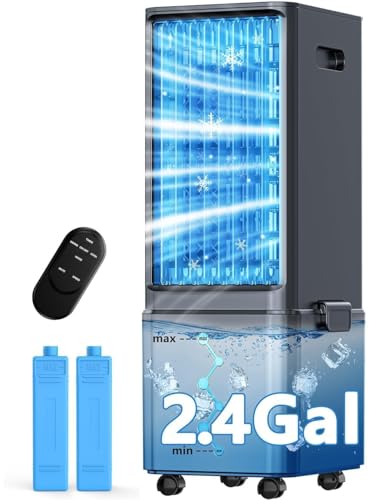
The COOLECH windowless evaporative cooler offers four modes and three speeds, delivering flexible cooling without a traditional window unit. A 20-foot remote enhances control from around the greenhouse, while a waterless alert system helps prevent dry-running and protects equipment. The 3-in-1 capability (cooling, fan, humidification) is useful for dry greenhouse climates where maintaining humidity is beneficial for plant health. Its portability and 22 ft/s maximum airflow suit medium-to-large greenhouse bays that require scalable cooling on demand.
Auertech 48″ 6500 CFM Swamp Cooler

The Auertech 48″ unit drives 6,500 CFM through a large 48-inch footprint, making it ideal for expansive greenhouse spaces or high-load areas. The model includes a 19-gallon tank and eight ice packs to boost chilling power, supporting longer intervals between refills. Wheels make repositioning straightforward, and the 120° oscillation helps distribute cool air evenly across benches and growing beds. This cooler is well-suited for large greenhouses where rapid, sustained airflow is needed to maintain uniform temperatures and humidity levels for diverse plant species.
Buying Guide: Key Purchase Considerations
- Cooling capacity and space: Match CFM to greenhouse square footage. Larger greenhouses benefit from higher airflow units like 3,000–6,500 CFM, while smaller spaces may suffice with 1,300–2,000 CFM models.
- Water supply and maintenance: Tank capacity and refill frequency influence downtime. Consider continuous-fill options or taller tanks for longer runs, and look for easy cleaning features to prevent mineral buildup.
- Humidity management: Evaporative cooling adds moisture to the air. For humid climates or humidity-sensitive plants, opt for models with humidity control modes and adjustable fan speeds to prevent over-saturation.
- Mobility and layout: Greenhouse layouts vary—units with wheels and lightweight frames offer flexibility for seasonal rearrangements or shifting cooling zones alongside plant beds.
- Power and energy use: Compare energy consumption relative to airflow. High-CFM units may require more power, but evaporative cooling generally offers lower operating costs than traditional AC in dry climates.
- Maintenance and accessories: Look for accessible pads, easy drainage, ice packs compatibility, and remote controls for convenient operation from different greenhouse zones.
- Durability and enclosure: Pick weather-resistant housings for outdoor setups and units with corrosion-resistant components if humidity and fertilizer fumes are present near benches.
In selecting a cooler for a greenhouse, consider climate, plant types, and bench layouts. A combination approach—using a high-CFM unit for main airflow and a smaller, mobile cooler for targeted zones—can optimize temperature and humidity control while keeping energy use reasonable. For best results, align cooling strategy with irrigation schedules and venting plans to prevent hot spots and ensure uniform growth conditions across the greenhouse.