Best Expansion Tanks for Boiler Systems: A Practical Guide for Home and Commercial Heating
Choosing the right expansion tank is essential for protecting boiler systems from pressure changes due to heating water. This guide covers top-rated options, highlighting capacity, construction, and installation considerations. Whether you’re upgrading an old system or installing a new one, the right expansion tank helps prevent leaks, reduces water hammer, and extends equipment life. Below is a concise buying guide followed by five carefully selected products that perform well in both residential and light commercial settings.
| Product | Brand | Capacity | Connection |
|---|---|---|---|
| Watts ETX-30 Non-Potable Water Expansion Tank | Watts | 4.7 gallons | 1/2″ MNPT |
| Amtrol 60 Extrol Boiler System Expansion Tank | Amtrol | 7.4 gallons | 1/2″ NPT |
| Amtrol 30 Extrol Boiler System Expansion Tank | Amtrol | 4.4 gallons | 1/2″ NPT |
| Eastman Thermal Expansion Tank | Eastman | 2 gallons | 3/4″ MIP |
| Flexcon PH5 FLEX2PRO Thermal Expansion Tank | Flexcon Industries | 2.1 gallons | 2-1/2″ connection |
Watts ETX-30 Non-Potable Water Expansion Tank

The Watts ETX-30 is designed for closed loop hydronic heating systems, featuring a 4.7-gallon tank volume and a 1/2″ MNPT connection. Its carbon steel construction with an epoxy finish provides durability in both commercial and residential environments. The tank includes a robust expansion membrane to minimize air-charge loss, helping maintain stable system pressure. Its straightforward mounting integrates directly into supply piping for flexible installation in various boiler setups.
Amtrol 102-1 Extrol 30 Expansion Tank
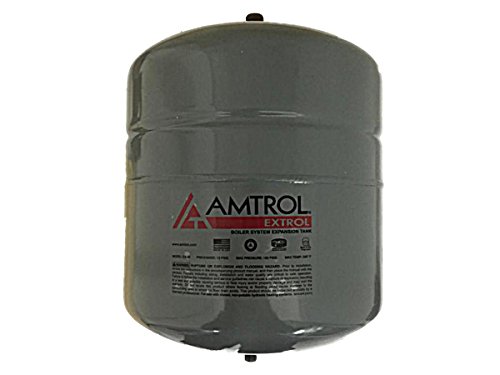
The Extrol 30 is an inline well tank designed for stable expansion control, featuring a watertight reservoir and a thick butyl/EPDM diaphragm for long service life. Its 4.4-gallon capacity makes it suitable for mid-size residential or light commercial boiler systems, providing reliable pressure control while minimizing cycling and hammer effects.
Amtrol 30 Extrol Boiler System Expansion Tank

The 30 Extrol offers a compact 4.4-gallon footprint with a 1/2″ NPTM connection and a maximum working pressure around 100 psi. This model is popular for space-constrained installations where reliable expansion control is needed without occupying significant wall or cabinet space.
Eastman Thermal Expansion Tank

Eastman’s 2-gallon thermal expansion tank features a 3/4″ MIP connection and a durable butyl rubber diaphragm with a stainless steel system connection. It ships pre-charged at 40 psi, simplifying installation and ensuring immediate stability against thermal expansion in water heater or small boiler setups.
Flexcon PH5 FLEX2PRO Thermal Expansion Tank

The Flexcon PH5 FLEX2PRO uses a 100% butyl diaphragm and a plastic liner to fully separate the system water from the tank’s air precharge. Its stainless steel nipple helps prevent corrosion at the connection, and the tank is finished with appliance-quality paint to resist external corrosion. This model suits modern systems prioritizing durability and longevity.
Taco 400-4 Hy-Vent Expansion Vent

Note: While not a traditional expansion tank, the Taco 400-4 Hy-Vent is included for systems that require air elimination and venting as part of boiler protection. It features sturdy brass construction, supports hot water radiators and baseboards, and allows cleaning of the top for maintenance. It is rated for pressures up to 150 psi and complements expansion tanks in complete hydro-thermodynamic protection schemes.
Eastman Thermal Expansion Tank (Revisited)
Revisiting Eastman provides a compact, pre-charged option ideal for smaller water-heating circuits or restricted spaces. The combination of a reliable diaphragm and pre-charge helps minimize pressure fluctuations and supports smooth boiler operation in residential contexts.
Buying Guide: Key Purchase Considerations
- System type and size: Match tank capacity to your boiler’s volume and expected thermal expansion. Larger homes or commercial systems typically need bigger tanks for stable pressure and fewer relief valve activations.
- Diaphragm material and design: Diaphragms made from butyl EPDM or similar materials offer durability and compatibility with potable water. A robust membrane reduces air charge loss and extends service life.
- Connection size and compatibility: Common connections include 1/2″ MNPT and 3/4″ MIP. Verify the correct threading and ensure it fits your piping with minimal adapters.
- Pre-charge pressure: Tanks are pre-charged to a specific PSI. For safety and performance, set the pre-charge to about 80% of your system’s running pressure, typically around 38–40 PSI for residential systems.
- Material and corrosion resistance: Carbon steel tanks with epoxy finishes resist corrosion in heating environments. Stainless components and corrosion-resistant nipples improve longevity in potable and non-potable applications.
- Maintenance and serviceability: Look for tanks with accessible diaphragms and cleanable components. Some models offer easier inspection and replacement parts, reducing downtime.
- System-specific features: Some tanks are designed for potable water systems, while others target non-potable or closed-loop heating networks. Confirm compatibility with your setup and local codes.
- Budget and space constraints: Sub-compact tanks save space but may be undersized for larger systems. Balancing capacity, footprint, and total cost is essential for optimal performance.
The right expansion tank protects boilers from pressure surges, helps manage water hammer, and prolongs system life. When selecting a model, consider capacity, diaphragm material, connection type, and whether the tank is designed for potable or non-potable use. For mixed installations, pairing a compact, high-quality tank with a reliable vent or air elimination device can provide comprehensive protection against pressure fluctuations.