Best Pool Heat Exchangers for Efficient Water Heating and Solar Compatibility
Choosing a reliable heat exchanger for your pool reduces energy costs and extends the swimming season. This guide highlights five top-rated pool heat exchangers available on Amazon, covering stainless steel, titanium, and 304/316L options. Each model is evaluated for performance, durability, and compatibility with solar heating or spa systems. Use the buying guide at the end to compare capacities, materials, and installation considerations.
Summary of chosen products at a glance:
| Product | Material | Capacity (approx.) | Ports | Best For |
|---|---|---|---|---|
| AB Pool Heat Exchanger 300 kBtu | 316L Stainless Steel | Up to 23,800 gal | 2″ & 1.5″ FPT | Large pools, solar heating |
| Jiabailie 200KBTU Pool Heat Exchanger | 304 Stainless Steel | Freshwater 200 kBtu/hr | 1″ & 1.5″ FPT | Steady heating, spa integration |
| AB Pool Heat Exchanger 155kBtu | 316L Stainless Steel | Up to 11,900 gal | 1.5″ & 1″ NPT | Mid-size pools, spa/w belt |
| DEIGEHJRE Pool Heat Exchanger | 304 Stainless Steel | 200 kBtu/hr | 1″ & 1.5″ FPT | Compact setups, fast heating |
| AB 360 kBtu Titanium Heat Exchanger | Titanium | Up to 29,000 gal | 2″ & 1.5″ FPT | Saltwater pools, longevity |
AB Pool Heat Exchanger 300 kBtu: Stainless Steel 316L, Large Capacity

The AB 300 kBtu pool heat exchanger is designed for larger residential or small commercial pools. Constructed from stainless steel 316L, it resists chemical treatment and chlorine commonly used in pools and spas. This unit supports high-temperature differentials to transfer heat efficiently, delivering up to 300 kBtu/hr under typical conditions. Its dual port arrangement—2″ and 1.5″ FPT—facilitates straightforward installation with common pool and solar loops. A one-year warranty provides basic assurance against manufacturing defects.
Key features include corrosion resistance in swimming pool environments and solid performance under high flow. The unit is suited for solar heating compatibility and can be integrated into heat pump or boiler-assisted systems. For pool owners seeking robust, long-lasting materials with substantial heating capacity, this exchanger is a strong option. Consider matching it with properly sized pumps and compatible solar controllers to maximize efficiency.
Jiabailie 200KBTU Pool Heat Exchanger

The Jiabailie 200KBTU exchanger features a 304 stainless steel shell with 4.8 square feet of heat transfer area, appropriate for swimming pools, hot tubs, and solar heating setups. It is designed to maintain a stable temperature by transferring heat indirectly between hot and pool water circuits. This model emphasizes quick heating with a cited 200 kBtu/hr rate, enabling faster warm-up periods compared to smaller exchangers. The durability of 304 stainless steel contributes to extended service life in chemical-treated water environments.
With its 1″ and 1.5″ FPT connections, installation flexibility is favorable in common pool plumbing layouts. The unit is well-suited for spa integrations or solar-assisted heating systems where maintaining comfortable water temperatures is a priority. Potential buyers should evaluate their pool volume, desired heating rate, and existing heating source to determine if this exchanger aligns with their energy goals and system design.
AB Pool Heat Exchanger 155kBtu: Stainless Steel 316L, Mid-Size Pools

The AB 155kBtu exchanger provides a balanced option for mid-size pools. Its 316L stainless steel construction delivers corrosion resistance suitable for chemical-treated water. With ports configured as 1.5″ and 1″ NPT, the unit integrates with typical pool and spa piping. A 155 kBtu/hr heating capacity suits pools around 11,900 gallons, making it a practical choice for homeowners seeking reliable heating without oversizing the system. The included warranty underscores manufacturer confidence in long-term performance and durability.
Operators should consider system compatibility, including the presence of solar or boiler assists, to optimize energy usage. Properly sizing a pump to maintain adequate flow rates will ensure maximum heat transfer and prevent overheating of the heat exchanger. This model sits well for families or households planning future expansion or seasonal use shifts.
DEIGEHJRE Pool Heat Exchanger: 200 kBtu, 304 Stainless
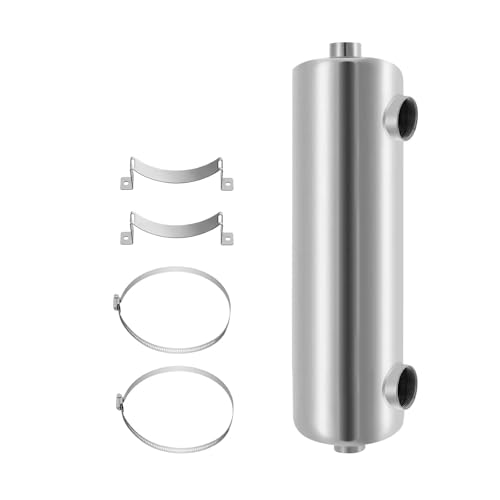
The DEIGEHJRE exchanger emphasizes durability with 304 stainless steel and a 200 kBtu/hr heating rate. Its surface area supports robust heat transfer for pools, spas, or hot tubs, particularly when paired with solar or boiler-based heat sources. The 1″ and 1.5″ FPT ports provide flexible installation options across various plumbing configurations. This model targets users who want reliable performance with a compact footprint, enabling efficient heating without occupying excessive space.
The design focuses on fast heating with a 60°C (140°F) differential, which helps avoid long wait times for warm water. For solar integration, verify compatibility with panel arrangements and controller logic to optimize daily heat gains. Regular maintenance of stainless steel surfaces—especially in chemically treated water—helps preserve performance and prolongs exchanger life.
AB Titanium Heat Exchanger 360kBtu: Saltwater Ready

The AB 360 kBtu titanium unit is built for extreme longevity, utilizing anti-corrosion titanium with titanium filling material. This design makes it suitable for saltwater pools, where stainless steel can be challenged by chloride exposure. The unit offers 2″ FPT on one side and 1.5″ FPT on the other, facilitating integration with larger water circuits. Its impressive 360 kBtu/hr capacity supports extensive heating needs and higher flow rates, making it ideal for saltwater pools or spa installations requiring robust, durable performance.
When considering a titanium exchanger, owners should weigh upfront costs against long-term maintenance savings due to reduced corrosion and potential downtime. Titanium is typically more resilient in harsh water chemistry, but installation should ensure proper insulation and protective coatings to maximize efficiency. As with all heat exchangers, pairing with an appropriately sized pump and compatible controller enhances overall system performance.
Buying Guide: Key Considerations For Pool Heat Exchangers
Selecting the right heat exchanger involves balancing capacity, material, and system compatibility. Here are essential factors to evaluate:
- Pool size and heating goals: Larger pools or more aggressive heating expectations require higher kBtu/hr ratings. Match the exchanger’s capacity to the pool volume and the desired recovery time.
- Material durability: Stainless steel 316L offers strong corrosion resistance for chemical-treated pools, while 304 stainless is a solid choice for many setups. Titanium provides superior saltwater performance but comes at a higher price.
- Port configuration and compatibility: Ensure the unit’s port sizes (FPT or NPT) align with your plumbing and any solar loop integrations. Off-the-shelf adapters may be needed for a clean fit.
- Temperature differential and control: Exchangers rely on a temperature difference between the heat source and pool water. Verify your heating source’s ability to sustain the differential and integrate with a pool controller or solar controller.
- Maintenance and warranty: Look for units with warranties and corrosion resistance warranties that reflect expected lifespans in chlorine or saltwater environments. Regular cleaning of heat exchanger surfaces helps maintain efficiency.
- Compatibility with solar and auxiliary heating: If you rely on solar panels or boilers, confirm compatibility and control strategies to optimize heat transfer and prevent overheating or short cycling.
Installation considerations should include professional assessment of flow rates, pump sizing, and clearance for service access. While higher-capacity units deliver faster heating, they also require adequate pumping and distribution to realize the full benefit. For saltwater pools, titanium units offer longevity, though stainless variants may suffice for typical residential pools with careful chemical management.