Best Laminar Flow Hood for Mycology: Top Picks for Mushroom Cultivation
Choosing the right laminar flow hood is essential for maintaining sterile conditions in mycology workflows, from inoculation to transfer work. The following selections are among the most relevant options for mushroom cultivation, showcasing reliable filtration, stable airflow, and user-friendly design. Each product is evaluated for its suitability in mycology environments, including cleanroom compatibility and ease of use in sterile procedures.
| Product | Brand | Main Benefit | Key Feature |
|---|---|---|---|
| Laminar Flow Hood with H13 HEPA Filter | Shroomagic | Reliable sterile work area | 20 × 15 inch working area; H13 HEPA; dual fans; built-in LED |
| Bonsai 12″x12″ 99.99% HEPA Horizontal Hood | Myco Labs | Compact, replaceable filter | 99.99% HEPA; 110V; USA-made |
| Bella Bora Still Air Box | Bella Bora | Durable still air enclosure | Updated visibility; glove-free design; durable |
| YJINGRUI Laminar Flow Hood | YJINGRUI | Adjustable flow with H-14 | H-14 HEPA; 0.3–0.65 m/s; 22.6×22.6 in |
| Yzzwer Laminar Flow Hood FFU | Yzzwer | Strong, adjustable laminar flow | H13 HEPA; 0.45–0.60 m/s; up to 800 m³/h |
Below are five detailed product sections that highlight features most relevant to mycology work, followed by a concise buying guide to help compare options.
Laminar Flow Hood With H13 HEPA Filter – Shroomagic

Shroomagic’s laminar flow hood provides a spacious work area and stable laminar performance. The unit measures 20 × 16.8 × 7.9 inches with a 20 × 15 inch working surface, delivering 0.35–0.5 m/s airflow and up to 249 CFM. An H13-grade HEPA filter captures 99.95% of 0.3 µm particles, making it suitable for mycology, tissue culture, and cleanroom applications. Dual DC brushless fans support steady flow, while a built-in LED light enhances visibility during inoculation, agar transfers, and other sterile tasks. The 24V DC system includes a 100–240V adapter for flexibility.
Bonsai 12×12 Horizontal Laminar Flow Hood – Myco Labs

This portable horizontal laminar flow hood from Myco Labs features a compact 12×12 inch workspace with a replaceable 99.99% HEPA filter designed for long life. The unit is crafted in the USA and emphasizes ease of replacement to maintain consistent sterile conditions for mushroom cultivation, agar work, and petri dish handling. Its horizontal airflow configuration helps direct a clean airstream over your work area, reducing contamination risk during transfers and innoculations.
Bella Bora Still Air Box Mycology Box
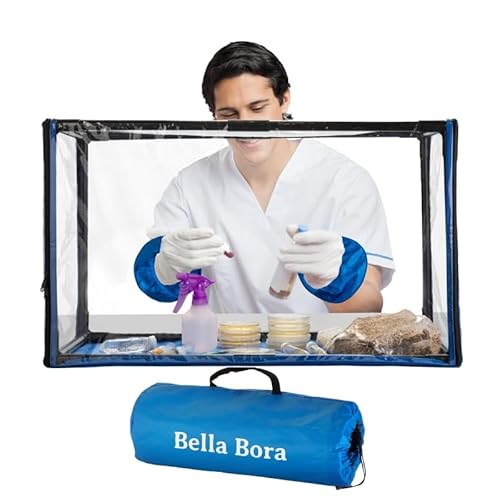
Bella Bora’s still air box is designed as a sturdy alternative to traditional laminar flow hoods. It emphasizes durability, visibility, and arm flexibility with Exosphere arm ports for easier access to tough angles while maintaining a snug seal. The product is scratch-resistant, waterproof, and designed for prolonged use, which can support inoculation, agar work, spore handling, and as a sterile workspace for various mycology tasks. It is intended to minimize disturbance of the sterile field while using disposable gloves as needed.
YJINGRUI Laminar Flow Hood – H-14 HEPA

The YJINGRUI model employs an H-14 HEPA filter with ISO Class 5 cleanliness, designed for mycology, clean rooms, and laboratory work. The hood measures 22.6×22.6 inches with adjustable three-speed airflow. The included fan and filter unit support stable laminar flow and filtration of up to 99.995% of particles at 0.3 microns, helping maintain a sterile environment during inoculation and culture handling. It operates on 110V power with a measurable noise profile suitable for lab settings.
Yzzwer Laminar Flow Hood FFU – 0.45–0.60 m/s

The Yzzwer FFU hood features a modern fan-filter unit with a three-position push-button control and an adjustable airflow range of 0.45–0.60 m/s. It boasts a high performance with an airflow capacity reaching 800 m³/h and 99.99% filtration for particles around 0.3 microns. Built for reliability, the durable aluminum frame and sealed construction support long-term use in mycology tasks such as spore work, agar transfers, and culture maintenance.
Buying Guide: Key Purchase Considerations For Mycology
- Filtration level and cleanliness class: For mushroom cultivation and tissue work, HEPA filters rated at H13 or H14 provide strong particle reduction. Consider ISO Class 5 (Class 100) standards as a benchmark for sterile work areas.
- Airflow configuration: Laminar, unidirectional airflow directly over the work surface minimizes turbulent contamination. Horizontal flow hoods are common for direct air sweeping across the workspace, while still-air boxes are lower-profile options for compact setups.
- Filtration efficiency and particle size: Look for filters capable of removing 99.95%–99.995% of 0.3 µm particles. The higher the filtration rating, the better for high-sterility applications, though this may come with cost and complexity.
- Workspace size: Match the work surface to your typical tasks—culturing, plating, and inoculation may require 12×12 in to 20×15 in surfaces. Ensure the overall unit fits your bench space and accessibility needs.
- Maintenance and filter replacement: Replaceable HEPA filters simplify upkeep. Consider ease of access, availability of replacement parts, and available service in your region.
- Power and compatibility: Check voltage compatibility (110V is common in the US) and whether a unit includes a universal adapter for flexibility in varied setups.
- Durability and materials: Durable frames (aluminum or reinforced steel) and splash-resistant surfaces help in long-term use. Portable designs may benefit mobile labs or small-scale setups.
- Light and visibility: Integrated LED lighting improves accuracy during delicate steps. Ensure lighting is bright, adjustable, and free from glare on transparent surfaces.
- Safety and ergonomics: Consider arm access, glove ports (if applicable), and ease of cleaning to reduce contamination risk and improve workflow efficiency.
- Budget versus performance: Higher filtration and larger work areas come with higher costs. Prioritize features that directly support your most frequent mycology tasks.
Selecting a laminar flow hood for mycology involves balancing filtration quality, workspace size, and maintenance needs. Users may prefer a larger, heavy-duty hood for routine inoculation and transfers or a compact unit for space-limited setups focusing on spore handling and small culture work. Evaluating product specifications against your typical workflow will help identify the best fit for sterile procedures in mushroom cultivation.