Best Leak Detectors for AC Systems in 2025
Finding a reliable leak detector for air conditioning systems is essential for accurate diagnostics and quick repairs. The following selections emphasize infrared and UV-dye detection, offering strong sensitivity, long sensor life, and versatile compatibility with common refrigerants. Use this guide to compare key features, battery life, and ease of use across top brands.
Summary Table
| Product | Brand | Max Sensitivity | Detection Type | URL |
|---|---|---|---|---|
| ILD-200 | Elitech | 0.14 oz/yr | Infrared halogen refrigerants | View |
| SFD201 | SENSYX | Not specified in listing | Halogen refrigerants | View |
| WJL-6000S | Elitech | 0.21 oz/yr | All halogenated gases | View |
| RT-389 | TOPTES | 0.1 oz/yr | R- and other halogen refrigerants | View |
| VIVOHOME | VIVOHOME | 0.03 oz/yr | R134a, R410a, R1234yf and more | View |
This selection focuses on infrared and dye-based options, balancing accuracy, user-friendly interfaces, and broad refrigerant compatibility for American HVAC technicians and DIYers alike.
Elitech ILD-200 Infrared Leak Detector
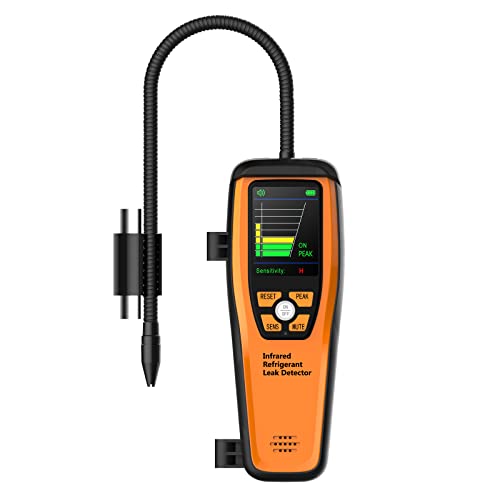
Elitech’s ILD-200 is an infrared-based refrigerant leak detector designed to resist interference while delivering fast response times. It supports detecting halogenated gases and blends such as R11, R22, R404A, R410A, R600a, and R1234yf. Maximum sensitivity reaches 0.14 oz/yr, enabling reliable pinpointing of leaks in automotive and HVAC contexts. The detector’s infrared sensor contributes to longer service life compared with heated diode options, making it a solid choice for frequent diagnostic work.
SENSYX SFD201 Rechargeable HVAC Leak Detector

The SFD201 operates on a rechargeable lithium battery, emphasizing cordless convenience for mobility around HVAC systems. It uses a Japan-made heat-dioxide semiconductor sensor, renowned for sensitivity and reliability in detecting gas leaks. The device features adjustable sensitivity with High/Low levels, facilitating use across different environments, from tight automotive cabins to sprawling commercial units.
Elitech WJL-6000S Freon Leak Detector

The WJL-6000S from Elitech detects a wide range of halogenated refrigerants, including CFCs, HFCs, HCFCs, and blends. It touts seven adjustable sensitivity levels and dual indicators for audible and visual alarms, plus battery status indicators. This model is designed for HVAC maintenance and auto AC diagnostics, offering strong detection performance across common refrigerants found in North American systems.
TOPTES RT-389 Rechargeable Leak Detector

TOPTES RT-389 combines a Japanese semiconductor sensor with three sensitivity modes and three alarm types (sound, visual, vibration). The detector reaches a maximum sensitivity of 3 g/yr (0.1 oz/yr) and includes a 14.5-inch flexible gooseneck for hard-to-reach areas. A TFT color display provides real-time readings, with a dual display option and a quick mute feature for noise-sensitive environments. It’s well-suited for automotive, residential, and commercial HVAC tasks.
VIVOHOME Rechargeable HVAC Leak Detector

The VIVOHOME detector offers a three-mode sensitivity with a maximum of 0.03 oz/yr. It features a 30-second warm-up and a rapid 3-second response, helping technicians locate leaks quickly. Visual and audible indicators communicate leak severity, and the device includes a peak function to track the maximum leak level. Its 15.8-inch sensor and large LCD screen support precise navigation of hard-to-access areas and clear test results.
Buying Guide: Key Considerations For AC Leak Detectors
Selecting the right leak detector depends on refrigerant type, environment, and workflow. Here are essential factors to weigh:
- Sensor Type and Sensitivity: Infrared detectors excel in rapid response and durability, while dye-based UV detectors excel for dye-based leak detection. Consider maximum detectable leak rate (oz/yr or g/yr) and whether you need adjustable sensitivity for different systems.
- Refrigerant Coverage: Ensure the detector supports common R-22, R-410A, R-134A, R-404A, R-1234YF, and blends used in your region. All-around models are best for mixed fleets.
- Power and Portability: Rechargeable lithium batteries enable cordless operation for mobile inspections. Check battery life and charging options (USB-C, internal battery, etc.).
- Response and Alarm Features: Look for audible, visual, and vibration alerts. A peak function helps identify the primary leak point, while a backlit display improves readability in dim environments.
- Probe Design and Accessibility: Long, flexible goosenecks and elongated sensors improve access to tight spaces and automotive lines. Consider display size and readability during inspections.
- Durability and Battery Life: Choose devices with robust housings and long sensor life for professional use. Verify warranty terms and availability of spare parts or replacements.
- Software and Maintenance: Some models offer maintenance reminders, calibration options, or easy sensor cleaning. UV-dye kits and compatible oils may be needed for dye-based systems.
Across the featured options, users can balance infrared versus UV-dye approaches, considering the system type (auto versus home HVAC), refrigerant blends, and the preferred workflow. For technicians dealing with a mix of R-410A and older halogenated refrigerants, a detector with broad halogen coverage and robust sensitivity—such as the Elitech ILD-200 or WJL-6000S—provides reliable results. For dye-focused inspections, the TOPTES RT-389 and VIVOHOME models offer comprehensive features and user-friendly interfaces suitable for on-site diagnostics.