Best Mixing Valves for Boiler Systems: Top Picks for Safe, Consistent Temperatures
Choosing the right mixing valve for a boiler helps ensure safe, consistent water temperatures, protects appliances, and reduces the risk of scalding. This guide highlights five leading thermostatic mixing valves, focusing on durable construction, compatibility, and reliable temperature control. Each selection is suitable for residential boiler setups and comes from reputable brands. Read on to compare features, installation notes, and what to consider when selecting the best valve for your system.
Product Overview
| Product | Brand | Main Benefit | Link |
|---|---|---|---|
| Cash Acme 3/4 HG110 | Cash Acme | Safe outlet temp 120°F; versatile connections | View |
| Cash Acme 1/2 HG110-D | Cash Acme | Compact, ideal for tight spaces | View |
| Honeywell AM-1 Sparco | Honeywell | Proportional thermostatic control | View |
| Cash Acme 3/4 HG110-D Sweat | Cash Acme | Barb connections for easy piping | View |
| Taco 5004-HX-C3 | TACO Metals | High-flow, 1″ union design | View |
Note: The table above highlights five valves that balance temperature protection, compatibility, and installation flexibility for boiler systems. Each product section below provides deeper details, installation considerations, and reference to key features.
Cash Acme 3/4 HG110 Thermostatic Mixing Valve

The Cash Acme 3/4 HG110 thermostatic mixing valve delivers tempered water at a safe 120°F (or lower) from all outlets, while permitting the water heater to operate at higher setpoints, such as 140°F. This helps protect fixtures and occupants without sacrificing hot water availability. The valve’s design supports compatibility with SharkBite copper tubing, CTS, CPVC, SDR-9 HDPE, and PEX fittings, simplifying installation in a variety of plumbing configurations. Constructed from lead-free brass, it offers durability and long service life in boiler systems where reliable tempering is essential.
Key considerations:
- Safe outlet temperature ensures scald protection in household plumbing.
- Triple-listed thermostatic performance supports reliable long-term operation.
- Solid brass body resists corrosion and leaks in boiler environments.
Cash Acme 1/2 HG110-D Thermostatic Mixing Valve

This compact HG110-D model provides precise tempering to deliver safe tempered water at 120°F, even when the water heater is set higher. Its 1/2 inch connections and solid brass body make it well-suited for tight spaces within boiler installations. The valve remains compatible with common piping options including SharkBite copper tubing, CTS, CPVC, SDR-9 HDPE, and PEX, offering flexible integration in many residential systems. The durable construction supports long-term reliability in areas with fluctuating incoming water temperatures.
Key considerations:
- Ideal for space-constrained boiler rooms or crawlspaces.
- Maintains safe outlet temperatures to prevent scalding.
- Lead-free brass construction emphasizes longevity and safety.
Honeywell Home AM-1 Sparco Proportional Valve

The Honeywell AM-1 Sparco series focuses on proportional thermostatic control, a common requirement in more complex boiler systems where stable outlet temperature is crucial across varying flow rates. This model emphasizes American-made reliability and standard compatibility for residential installations. While specific temperature ranges are not listed in the summary features, Sparco valves are typically designed to deliver consistent water temperatures to protect both fixtures and users. The unit is built to withstand everyday boiler operation with a focus on safety and performance.
Key considerations:
- Proportional thermostatic performance supports variable flow conditions.
- Made for United States market with established Honeywell support.
- Compatible with standard domestic plumbing practices and fittings.
Atmama 1/2 NPT Thermostatic Mixing Valve
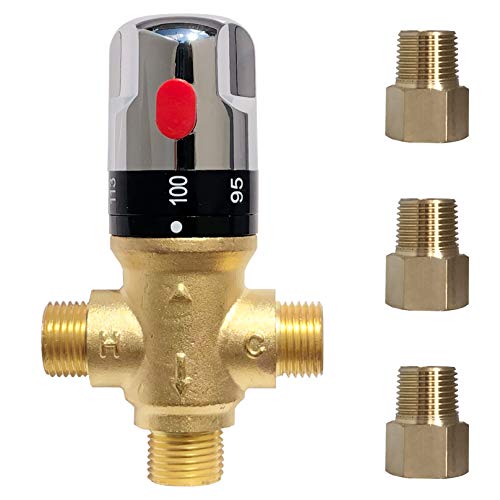
The Atmama 1/2 NPT valve uses a straightforward 1/2 inch NPT interface for easy installation in many residential boiler setups. Its temperature markings in Fahrenheit provide clear guidance, with an outlet water temperature range of 68°F to 122°F. The brass body is noted for durability and longevity. This model offers a balance of simplicity and reliable tempering control, suitable for standard home heating systems where basic mixing functionality is required.
Key considerations:
- Clear temperature markings aid correct setup.
- US standard fittings and one-piece brass body for reliability.
- Good option when a simple, direct installation is preferred.
Taco 5004-HX-C3 1″ Union Sweat Valve

The Taco 5004-HX-C3 is designed for higher flow and robust boiler applications, featuring a 1″ union sweat connection and a maximum flow of 20 GPM. Its hot and cold supply temperature ranges (hot 120-180°F, cold 39-80°F) provide flexible tempering for larger houses or more demanding boiler setups. This valve is suitable for those who need a high-capacity mixing solution capable of maintaining safe tempering at elevated hot water temperatures, with durable construction to match demanding conditions.
Key considerations:
- 1″ union sweat configuration supports durable, easy disassembly and maintenance.
- High flow capacity suits larger households or more intense boiler loads.
- Wide temperature range supports varied heating system requirements.
Buying Guide: Key Purchase Considerations
When selecting a mixing valve for a boiler, several factors influence performance, reliability, and compatibility. The following considerations help compare options and choose the best fit for your system.
- Temperature targets and safety: Most residential valves aim to deliver a safe outlet temperature around 120°F. Assess whether your setup requires a fixed limit or proportional control to adapt to varying flow rates.
- Connection type and size: Valves come with various connections (NPT, SharkBite, Barb, Union). Match the valve to your piping—copper, CPVC, PEX, or HDPE—and confirm compatible adapters if needed.
- Material quality: Brass bodies with lead-free construction offer durability and long-term reliability in heated water systems. Check for certifications and listings.
- Flow capacity: Some valves support higher GPM (gallons per minute) for larger homes or heavy-use scenarios. Ensure the unit can handle your boiler’s demand without throttling.
- Installation space: In tight boiler rooms, compact valves or inline models may fit better than larger, high-capacity units. Consider mounting options and service access.
- Maintenance and serviceability: Some designs allow easy disassembly for cleaning and replacement of internal components. Durability matters for longevity in hot water environments.
- Brand and support: Reputable brands often provide better documentation, parts availability, and technical support, which simplifies installation and troubleshooting.
- Compliance and safety: Look for valves that comply with regional plumbing codes and performance standards to ensure safe operation in your home.
Comparative notes:
- Compact models (like 1/2″ or 1/2″–3/4″ variants) are ideal for tight spaces but may have limited flow capacity.
- High-flow, 1″ union or barb variants suit larger households or more demanding heating systems but require more space.
- Fitting options (SharkBite compatibility vs. sweat or union connections) determine ease of installation and future maintenance.
To optimize boiler performance, select a valve whose temperature setting and flow characteristics align with your heater’s output and your household’s hot water needs. Consider professional installation if your existing piping uses specialized fittings or if you anticipate frequent maintenance.