Best Solar Roof Attic Fans for Home Cooling
Choosing a solar roof attic fan can reduce attic heat, improve HVAC efficiency, and cut energy costs. The following selections are among the most capable, weather-resistant options available for American homes, garages, greenhouses, and sheds. Each product uses solar power to vent hot air, with features like built-in thermostats, weatherproof housings, and adjustable mounting to maximize performance in different climates. Below you’ll find concise details and practical considerations to help compare top picks.
| Product | Brand | CFM | Power (W) | Coverage |
|---|---|---|---|---|
| DC HOUSE 32W Solar Attic Fan | DC HOUSE | Up to 3000 CFM | 32 | Up to 3000 sq ft |
| iLiving Hybrid Ready Solar Roof Attic Exhaust Fan | iLiving | 1150 CFM | 40 | Up to 2900 sq ft |
| OmniPV Solar Attic Fan | OmniPV | 1600 CFM | 40 | Home, greenhouse, garage, shop |
| Hon&Guan Solar Attic Fan With Thermostat | Hon&Guan | 2000 CFM | 40 | Up to 2500 sq ft |
| OmniPV Smart Hybrid Solar Attic Exhaust Fan Pro | OmniPV | 2850 CFM | 50 | Up to 4000 sq ft |
DC HOUSE 32W Solar Attic Fan
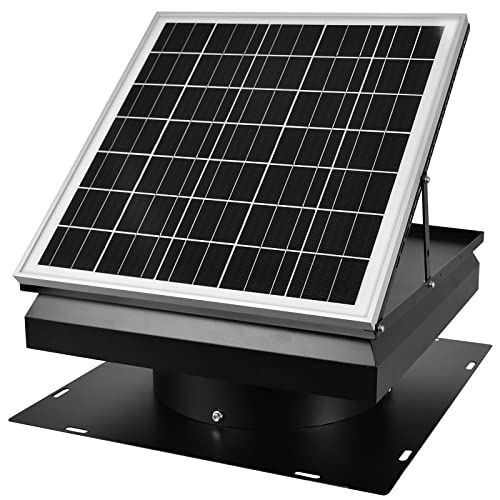
The DC HOUSE 32W Solar Attic Fan delivers solar-powered cooling with a brushless, weatherproof design. It uses premium monocrystalline panels and runs off-grid, automatically activating at sunrise and powering down at dusk. Its 9″ aluminum blades are designed for quiet operation while withstanding hail and weather conditions. Capable of moving up to 3000 sq ft of space, it is suitable for home attics, garages, barns, and RV rooftops in diverse climates. An integrated feature set supports passive cooling when paired with existing attic vents for broader airflow.
iLiving Hybrid Ready Solar Roof Attic Exhaust Fan

The iLiving model combines solar power with an intelligent thermostat control that ranges from 50°F to 122°F and includes an Enable/Disable feature. With a 40W solar panel and a 1150 CFM motor, it cools spaces up to about 2900 square feet. The unit features an IP68 waterproof brushless motor and adjustable solar panel angles (0°, 15°, 30°, 45°) to optimize sun exposure. The built-in thermostat supports automatic operation, while the long-term warranty provides reliability for year-round use in homes, workshops, and sunrooms.
OmniPV Solar Attic Fan

OmniPV’s 40W Solar Attic Fan emphasizes effective roof cooling with a 1600 CFM airflow and a weatherproof, low-noise build. The unit uses a brushless DC motor for efficiency and durability, with a built-in thermostat that automatically shuts off below 77°F (26°C). Its waterproof construction supports long life in exposed roof spaces, while the 40W solar panel ensures consistent performance across many sunny days, making it suitable for large rooms, greenhouses, and garages needing robust solar ventilation.
Hon&Guan Solar Attic Fan With Thermostat
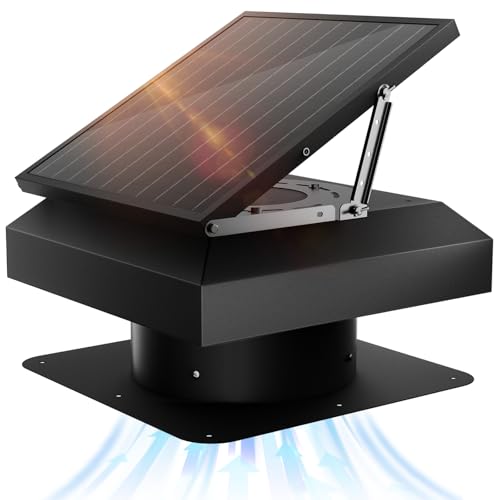
Hon&Guan’s 40W solar roof vent operates at up to 2000 CFM with a 24/7 capability via two modes and a thermostat. It can be adjusted up to 70° horizontally and vertically, enabling optimal solar exposure across seasonal changes. The unit supports continuous day-and-night operation when connected to the AC/DC adapter (sold separately) for two-mode functionality. A temperature-controlled auto-start feature helps regulate attic temperatures, cooling spaces up to about 2500 square feet while ensuring energy-efficient performance in varying climates.
OmniPV Smart Hybrid Solar Attic Exhaust Fan Pro

The OmniPV Pro model combines a 50W solar panel with a powerful 2850 CFM output, designed for spaces up to 4000 square feet. It features a German-engineered brushless DC motor and an advanced flow channel design to boost power efficiency by about 20% and CFM by over 50% compared to earlier generations. A thermostat allows automatic on/off control within a 50–104°F range, and continuous operation is possible with temperature settings adjusted to occupancy needs. The design is weatherproof, making it suitable for homes, sheds, and commercial spaces requiring strong solar ventilation.
Buying Guide: Key Considerations For Solar Roof Attic Fans
- CFM and space: Match airflow ratings to attic size and cooling needs. Larger spaces benefit from higher CFM models, but ensure the fan can start reliably under local sunlight conditions.
- Solar vs. hybrid operation: Pure solar units are maintenance-light and energy-free during daylight; hybrid or thermostat-controlled units offer flexibility for day-and-night use, especially in non-sunny climates.
- Temperature control: Built-in thermostats prevent unnecessary operation and help maintain comfortable interior temperatures. Look for adjustable setpoints for more precise cooling.
- Weather resistance: Outdoor roof installs require weatherproof housings, IP ratings, and durable blades to resist hail, wind, and rain. Materials like aluminum housings and stainless components increase longevity.
- Installation versatility: Consider mounting angles and ranges (horizontal and vertical) to maximize sun exposure. Some models offer -45° to +45° horizontal, 0° to 60° vertical adjustments for optimal positioning.
- Noise and reliability: Brushless DC motors reduce noise and provide longer life. Check decibel ratings if the attic is adjacent to living spaces.
- Smart features and automation: Thermostats, enable/disable modes, and automatic sun-up/sun-down activation simplify operation and improve energy savings.
- Maintenance: Look for easily accessible components and reputable warranties. A longer warranty reflects confidence in durability under harsh rooftop conditions.
- Compatibility: If replacing an existing vent, confirm dimensions, duct compatibility, and mounting hardware included with the unit.
- Cost vs. savings: While prices vary, factor in potential energy bill reductions, reduced HVAC strain, and potential insurance or mitigation benefits when evaluating long-term value.