Best Tankless Water Heaters for a Large Family With High Demand
Choosing a tankless water heater that can handle multiple simultaneous hot-water requests is essential for a large family. The following five models are selected for their capacity, efficiency, and suitability for household-wide use. Each product is evaluated for flow rate, energy efficiency, and ease of installation to help you compare options at a glance.
| Product | Brand | Key Benefit | Type |
|---|---|---|---|
| 14kW Tankless Water Heater Electric | Orbek | Up to 3.38 GPM for 2-3 points of use | Electric |
| Rheem 18kW 240V Tankless Electric Water Heater | Rheem | Up to 4.4 GPM with self-modulation | Electric |
| EcoSmart ECO 11 Electric Tankless Water Heater | EcoSmart | Energy-efficient, compact, space-saving | Electric |
| Rheem RTEX-24 24kW 240V Electric | Rheem | High-capacity for whole-home use | Electric |
| MIZUDO Tankless Water Heater Propane Indoor | MIZUDO | 3.6 GPM, suitable for 2-3 fixtures | Gas |
The following selections balance electric and gas options to suit different homes and energy setups. Each product is analyzed for flow capacity, installation considerations, and long-term efficiency, helping you pick a model that supports a large family’s daily hot-water needs without running out.
Orbek 14kW Electric Tankless Water Heater

The Orbek 14kW electric tankless unit supports up to 3.38 GPM and is suitable for 2-3 points of use simultaneously. It requires a 240V/60A two-pole breaker, 6 AWG wiring, and standard 1/2″ NPT water connections. With a focus on rapid hot water delivery (up to 3 seconds) and reduced scale buildup through water-electricity separation, this model aims to balance performance with energy efficiency. It is designed for homes where electric-only installation is practical and where space constraints favor compact equipment. The LED digital display provides straightforward operation and monitoring, though higher-demand homes may need multiple units or an auxiliary approach to ensure consistent supply across all fixtures.
Rheem 18kW 240V Tankless Electric Water Heater
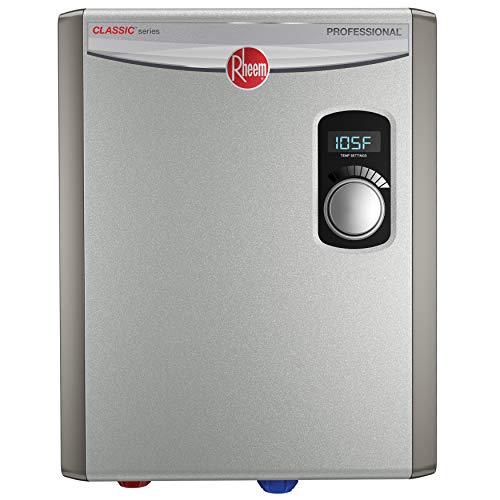
This Rheem model combines external digital thermostatic control with LED display and self-modulation to tune power to hot-water demand. With two durable copper immersion heating elements and a design that’s field serviceable, it supports flow rates up to 4.4 GPM. The unit is targeted toward households needing reliable on-demand hot water while preserving energy through precise control. Installation requires sufficient electrical service and clear access to the breaker panel. While powerful enough for whole-home use in many setups, geographic water temperature and simultaneous demand should be considered to avoid shortfalls during peak usage.
EcoSmart ECO 11 Electric Tankless Water Heater

EcoSmart’s ECO 11 is a compact 13 kW electric unit designed for space-saving installation with self-modulating technology. It provides endless on-demand hot water and maintains temperature with continuous monitoring and controlled flow to stay within a tight margin of the selected temperature. At about 11.5 x 8 x 3.75 inches, its small form factor makes it ideal for point-of-use or wall-mounted setups in homes needing efficient delivery of hot water across multiple fixtures. Its high efficiency and smaller footprint come with considerations about electrical service capacity and the number of fixtures served simultaneously in larger homes.
Rheem RTEX-24 24kW 240V Electric Tankless Water Heater
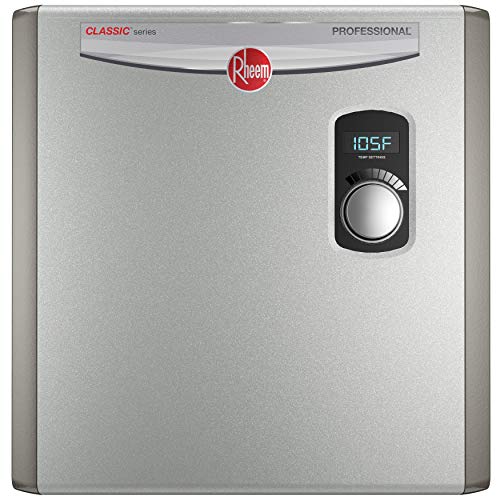
Rheem’s RTEX-24 offers high-capacity electric tankless heating with 24 kW, designed to deliver continuous hot water across the home. The installation requirements include three 40-amp double-pole breakers and a robust electrical service, with an adjustable ON/OFF dial and a digital temperature display offering precise control from 80 to 140 degrees Fahrenheit. This model is well-suited for larger households that can support a higher electrical load and need reliable performance even with multiple fixtures running concurrently. Availability of proper space in the breaker panel and electrical capacity are critical factors for successful deployment.
MIZUDO Tankless Water Heater Propane Indoor

The Mizudo propane model is rated at 3.6 GPM with an 80,000 BTU input, designed to supply hot water to 2-3 fixtures. It is UL-listed and CSA-certified for safety, with warranties spanning two years on the whole unit and five years on the heat exchanger. Installing a propane-compatible unit requires proper venting and clear space for gas appliance installation. For larger families in homes with natural gas access, the Mizudo model offers a strong balance of flow, gas efficiency, and safety features. Gas appliances require careful adherence to local codes and ventilation requirements to sustain dependable hot water delivery.
Buying Guide: Key Considerations For Large Families
- Flow rate and simultaneous use: Measure peak household demand (showers, sinks, laundry, and dishwasher) to choose a unit that can support multiple fixtures at once.
- Electric vs gas: Electric models are easier to install in many homes but may require upgrades to electrical service; gas units can deliver higher GPM in larger homes but require venting and gas line considerations.
- Space and installation: Compact models save space but review mounting options, especially for point-of-use or utility areas.
- Electrical service and panel capacity: Confirm available breakers, wire gauge, and overall panel space before selecting an electric unit.
- Ventilation and gas codes: For gas units, ensure proper venting, clearance, and compliance with local building codes to prevent safety risks.
- Efficiency and heat-up speed: Look for self-modulating technology and high efficiency factors to reduce energy use and ensure faster hot water availability.
- Maintenance and serviceability: Choose models with accessible service components and available replacement parts in your region.
- Warranty coverage: Longer warranties can reduce long-term ownership costs and indicate build quality.
Choosing a tankless water heater for a large family involves balancing flow capacity, energy type, and installation feasibility. The five models above illustrate a spectrum of electric and gas options designed to optimize hot-water delivery across multiple fixtures while maintaining efficiency and system reliability.