Best Tube Heaters for Garage Spaces: Efficient Heating for Your Workshop
Garage tube heaters offer focused warmth for workshops, vehicles, and DIY projects. This guide highlights five reliable options, covering gas, propane, and electric models. Each product includes installation notes, efficiency, and safety features to help you compare at a glance and choose the right heater for your space and climate.
| Product | Brand | BTU/Power | Fuel Type | Key Feature |
|---|---|---|---|---|
| SunStar Garage Tube Heater (LP) SIR45-15-L | Sunstar | 45,000 BTU | Propane | Compact 110″ length; up to 84.5% efficiency |
| SunStar Garage Tube Heater Natural Gas 45,000 BTU | Sunstar | 45,000 BTU | Natural Gas | Same compact length; high efficiency |
| InoKraft Maxheat MH125 125,000 BTU | InoKraft | 125,000 BTU | Propane | Large area coverage; auto on/off control |
| Mr. Heater F260550 Big Maxx MHU50NG | Mr. Heater | 50,000 BTU | Natural Gas | Flexible venting and accessible thermostat |
| TEMPWARE Electric Garage Heater 7.5kW | TEMPWARE | 7,500 W | Electric | Timer, ECO mode, ceiling mount |
SunStar Garage Tube Heater LP 45,000 BTU

The SunStar LP model is designed for garage spaces with a compact overall length of 110 inches, simplifying installation in tight areas. It delivers up to 84.5% efficiency and is installable as low as 8 feet above the floor, making it suitable for typical garage ceilings. Its LP configuration is best for regions with propane access and where ducting is not required. Safety features include robust construction and standard gas shutoff mechanisms common to tube heaters.
SunStar Garage Tube Heater Natural Gas 45,000 BTU

This natural gas variant mirrors the LP model with a 110-inch overall length for easy installation and high efficiency, reaching up to 84.5%. The installation height can start from 8 feet above the floor, which aligns with standard garage venting setups. Gas compatibility reduces ongoing fuel costs in gas-rich regions and eliminates the need for propane storage on site.
InoKraft Maxheat MH125 125,000 BTU

The MH125 is a high-capacity forced-air heater designed for larger garages or workshops up to 3,200 sq. ft. It features auto on/off control within a 25–95°F range and multiple safety protections, including overheat shutoff and auto-cut-off mechanisms. The unit includes a 10-foot hose, facilitating flexible installation. It’s CSA certified and engineered for rapid heat distribution with a wide heating pattern to cover open spaces efficiently.
Mr. Heater F260550 Big Maxx MHU50NG
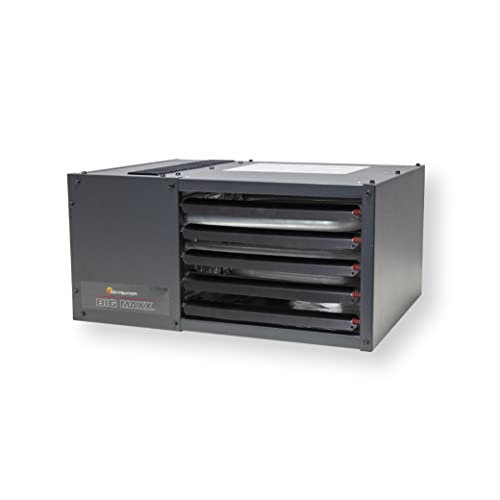
This natural gas unit heater is designed to heat up to 1,250 sq. ft. It offers powered exhaust and flexible venting options (vertical or horizontal), enabling installation in garages with varied layouts. The accessibility of thermostat and gas connections from outside the unit simplifies service and adjustments, which is beneficial for households that want straightforward temperature management and easier maintenance.
TEMPWARE Electric Garage Heater, 7.5kW
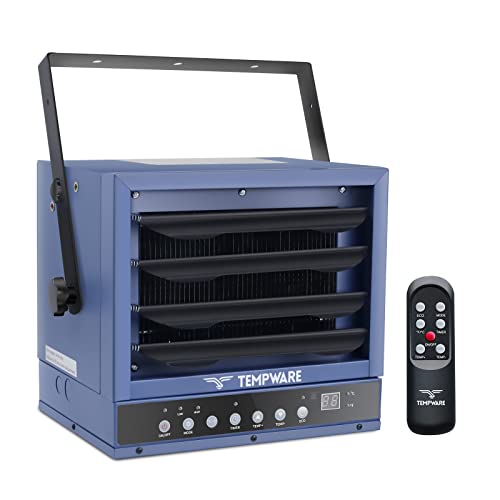
The TEMPWARE unit is a ceiling-mount electric heater offering 6,250–7,500 watts with two heat settings and an ECO mode. It includes a timer (1–12 hours) and a thermostat for precise control, enhancing energy efficiency in small-to-medium garages. An auto-overheat protection sensor adds a safety layer for continuous operation during long projects, and the adjustable louvers help direct airflow where needed.
Buying Guide
Key factors influence the right choice for garage heating. First, space size and layout determine whether a tube heater or ceiling-mounted unit is most effective. Large garages may benefit from higher BTU models (such as 100,000+ BTU propane or natural gas units), while smaller spaces can be adequately heated with 45,000 BTU models. Consider fuel availability and running costs: propane and natural gas typically offer lower ongoing costs in many areas, while electric units incur electricity charges but have easier installation and safer operation indoors.
Installation requirements vary. Gas heaters require proper venting, gas lines, and clearance from combustibles; some models allow outdoor-side venting or direct-vent configurations. Electric heaters require appropriate electrical circuits and, for ceiling-mounted units, secure mounting and clearance from reachable objects. Safety features to note include auto shut-off for overheating, flame sensor or thermocouple safety, and in electric models, thermostat control and ECO modes to minimize energy use.
Consider controllability and comfort. Auto on/off features simplify usage in variable climates. Thermostats help maintain steady temperatures, while adjustable airflow or tilting brackets improve directional heating. For garages with mixed activities—workbenches, vehicles, and storage—look for units with broader heat distribution or radiant elements that quickly warm objects and people in the space. Finally, assess maintenance needs and manufacturer’s certifications to ensure long-term reliability and safety.